Hi,
In less than two weeks, WordPress 7.0 is scheduled to be released. Are you ready? Or are you someone I used to be who waits two to three weeks to see what quirks early adopters find and if they warrant an early point release? Be that as it may, waiting only delays the inevitable, though, sooner or later you get to benefit from the new features and quality of life improvements to the Admin, Editor and Blocks.
The first version of the WordPress 7.0 Source of Truth has been published. It’s again a mammoth post of 4500 words, including 21 images and ten videos. I hope you enjoy the list of all the big and small feature and updates.
Next week, I will be on my way to Mumbai. The next weekend edition will arrive in your inbox after WordCamp Asia, on April 17th, 2026.
Yours, 
Birgit
PS: Should you be in Mumbai, grab a coffee of lunch spot from my public calendar, I’d love to meet you!
WordPress 7.0

WordPress 7.0 Release candidate 1 was moved to this week. The WordPress 7.0 RC2 was still on schedule for Thursday, though. Meanwhile, more Dev Notes were published.
Pattern Overrides in WP 7.0 is your heads-up to act before the release lands. WordPress 7.0 lifts the old restriction — Pattern Overrides now work with any block attribute that supports Block Bindings, not just a hardcoded Core block list. You opt in via the block_bindings_supported_attributes filter, and the post walks you through edge cases for static blocks where a render_callback may still be needed.
Pattern Editing in WordPress 7.0 explains that ContentOnly mode for unsynced patterns is now the default, meaning block structure and style controls are hidden from editors by default. Block authors need to audit "role": "content" attributes in block.json, theme authors should test their patterns, and plugin developers should verify UI components still render correctly under the new, more broadly applied editing modes.
Block Visibility in WordPress 7.0 dev note is relevant if your theme or plugin touches block markup server-side. The new viewport key inside blockVisibility metadata lets users show or hide blocks per device — mobile, tablet, desktop — via CSS, not DOM removal. If your code assumes blockVisibility is always a boolean, you’ll need to update it to handle an object too. No changes are needed if your blocks don’t interact with markup server-side.
Anne McCarthy walks through one of WordPress 7.0’s most-requested features: viewport-based block visibility. You’ll see exactly how showing or hiding any block by screen size works in practice — no extra plugins or CSS workarounds needed — and why it is relevant for responsive design. If you’ve been waiting for a native way to tailor content for mobile, tablet, and desktop separately, this is your preview before the April 9th release.
The Dimensions Support Enhancements in WordPress 7.0 comprise width and height as first-class block supports. Block builders and theme designer opt in with a single line in block.json, set defaults in theme.json, and the sidebar UI comes for free. Themes can also define named dimensionSizes presets, giving users a consistent palette rather than free-form inputs. If your block has custom width/height attributes today, this is a good moment to consider migrating.
A long-requested feature finally lands in WordPress 7.0. The dev note on Custom CSS for Individual Block Instances hold all the details. The new customCSS block support — enabled by default for all blocks — adds a Custom CSS field in the Advanced panel of the block inspector, scoped automatically to that instance via a generated class. Block authors whose blocks wrap raw or opaque content should explicitly opt out via block.json. If your render_callback is in play, make sure your block’s outermost element is a standard HTML tag.
A typography feature requested since 2021 finally arrives in WordPress 7.0, the dev note on the new textIndent block support has all the details for developers working on blocks or themes. Opt in with a single line in block.json, and a Line Indent control appears automatically in the Typography panel. Theme authors get theme.json configuration too, including a thoughtful subsequent vs all toggle that respects both LTR and RTL typographic conventions. No breaking changes — purely additive./
WordPress 7.0 ships a new Connectors API — and if you build AI-adjacent plugins, this dev note belongs on your reading list. The new framework standardizes how WordPress registers and manages connections to external services — starting with AI providers — giving you a consistent admin UI, API key management, and auto-discovery via the WP AI Client. Three providers ship out of the box: Anthropic, Google, and OpenAI. The wp_connectors_init action is your hook for registering additional connectors or overriding existing metadata.
Felix Arntz details the new AI Client landing in WordPress 7.0 — a provider-agnostic PHP API that lets your plugin send prompts for text, images, speech, or video without touching credentials or provider logic. You chain methods on wp_ai_client_prompt(), declare model preferences, and WordPress routes to whatever the site owner has configured. Three official provider plugins cover Anthropic, Google, and OpenAI. Client-side JS exists but remains admin-only for now.
Jorge Costa details the client-side Abilities API arriving in WordPress 7.0, the JavaScript counterpart to the PHP Abilities API introduced in 6.9. Two new packages handle it: @wordpress/abilities for pure state management and @wordpress/core-abilities for the WordPress integration layer that auto-fetches server-registered abilities via REST. You can register abilities with input/output schemas, permission callbacks, and annotations — laying the groundwork for browser agents and WebMCP integration.
Gutenberg 22.8
Gutenberg 22.8 release lead Dean Sas highlighted in his post What’s new in Gutenberg 22.8? (25 March) the following features:
- Real-time Collaboration improvements
- Button pseudo-state styling in Global Styles
- Site Logo & Icon in the Design panel
- Connectors extensibility
- Other Notable Highlights
The real-time collaboration improvements and the Connectors extensibility will make it into the WordPress 7.0 release.
I had a blast chatting with Beth Soderberg from Bethink Studio on the recording of Gutenberg changelog 129. We dove into some cool stuff like using AI, WordPress 7.0, and Gutenberg 22.8. It was such a fun convo, and we even touched on that little mental block some users might hit when they see the fresh new look of the wp-admin screens and try to wrap their heads around the change. The episode will drop into your favorite podcast app over the weekend. The 130th episode will be recorded after I return from WordCamp Asia.

 The latest episode is Gutenberg Changelog #128 – Gutenberg 22.7 Version and Dev Notes for 7.0 with special guest Maggie Cabrera

Plugins, Themes, and Tools for #nocode site builders and owners
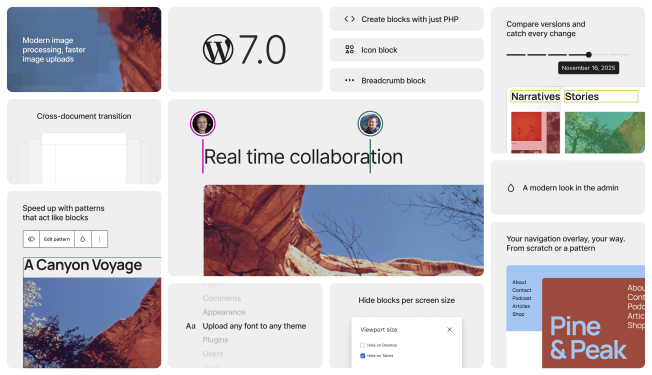
Courtney Robertson at GoDaddy breaks down what WordPress 7.0 brings when it ships April 9 at WordCamp Asia. Your editor finally gets real-time multi-user collaboration powered by Yjs, alongside visual block-level revisions, a Breadcrumbs block, Icon block, and customizable navigation overlays. Developers gain a provider-agnostic WP AI Client with a Connectors UI, PHP-only block registration, and Interactivity API improvements. The minimum PHP requirement bumps to 7.4 — worth flagging for clients on older hosting now.
A little over a month ago, Johanne Courtright, founder of Groundworx, launched r/WordPressBlocks, a dedicated Reddit community for developers and builders working with the block editor. A longtime block developer and free plugin author, Courtright created the space because scattered conversations about custom blocks, theme.json, full site editing, and Gutenberg’s direction deserved a proper home. All skill levels welcome — come share tips, tools, wins, and frustrations.
Theme Development for Full Site Editing and Blocks
If you’re finding it a drag to edit theme.json, check out Sérgio Santos‘s creation, WP Theme JSON Editor. It’s a VS Code and Cursor extension that makes dealing with JSON way easier with its cool visual interface. You can easily tweak colors, typography, spacing, and block settings using the official WordPress JSON Schema. Plus, it’s got handy features like CSS variable autocomplete, CodeMirror 6 syntax highlighting, drag-and-drop for palettes and font sizes, and real-time validation, and you even get to play with some experimental WP core properties. I’m not sure if it’s really easier than writing JSON from scratch, but hey, that’s just a personal choice, right?

You can now generate a block theme with Telex, Automattic’s experimental AI theme builder. You describe your site, hit “Enhance Prompt” to let Telex flesh out the design brief, optionally upload a reference image, then pick from four generated variations. From there you build out additional page templates, refine typography and colors conversationally, and download a ready-to-install ZIP containing your templates, styles, and theme.json — no PHP or CSS knowledge required.
Building Blocks and Tools for the Block editor.
Troy Chaplin launched Veils of Fate, a choose-your-own-adventure game built in WordPress using the Interactivity API, post types, and taxonomies. Spanning 3 acts, 18 quests, and 112 scenes, the story was co-written with Claude AI. If you love interactive storytelling, this one’s for you. Nano banana handled the pixel art, Miles created the theme, and Kinsta provides the hosting. A family-inspired project: Troy’s kids are avid readers and his wife is a librarian.
WordPress Studio is a free, open-source local development tool powered by WordPress Playground that has been around for two years now. The team has now published wp-studio the CLI installer you can use to spin up local sites instantly — no Docker, NGINX, Apache, or MySQL required — sync them with WordPress.com or Pressable, share live preview links with clients, and tap into a built-in AI assistant that runs WP-CLI commands natively. It’s only early access to there might be dragons.  Also available in WordPress Studio you can use phpMyAdmin to access the database and use it dark mode.

Carlo Daniele at Kinsta walks you through building PHP-only Gutenberg blocks, a feature introduced in Gutenberg 21.8 that lets you register blocks entirely in PHP—no React, Node.js, or build steps required. Using the new auto_register support flag, your attributes automatically generate inspector controls in the editor. You’ll build a pricing card block and learn how to wrap legacy shortcodes as proper blocks, finally giving your PHP-side clients and developers a gentler path into the block editor. It will also come to a WordPress instance near you soon with WordPress 7.0.
If you’d rather watch a video for education, Brian Coords demonstrates how PHP-only block registration in WordPress 7.0 removes the build-tool barrier entirely You’ll see a Hello World block built with custom fields, a WooCommerce integration using the Store API, and how to handle frontend JavaScript when backend JS has limitations. The real payoff comes when you combine PHP-only blocks with Claude Code skills, letting you generate blocks through conversation rather than scaffolding. The code is on GitHub.
Playground News
On this episode of The WP Minute+, Eric Karkovack sits down with WordPress contributors Alex Kirk and Brandon Payton to explore my.WordPress.net, a browser-based WordPress sandbox built around privacy, portability, and AI. Think personal CRM, private family blogging, chat-to-blog workflows, and an AI playground — all running in your browser without a server. The demo shows how plugins become app-like modules, how messaging apps like Beeper can feed content in, and how AI can modify plugins live. Your data stays yours, portable across devices.
AI in WordPress
Fellyph Cintra announces that AI coding agents can now connect directly to WordPress Playground via MCP, thanks to the new @wp-playground/mcp package built by Berislav Grgicak. One command wires up Claude Code or Gemini CLI to a browser-based Playground instance over WebSocket, letting your agent read and write files, execute PHP, manage sites, and navigate pages — all locally, without touching WordPress admin. Think plugin testing, live database debugging, and theme scaffolding driven entirely by conversation.
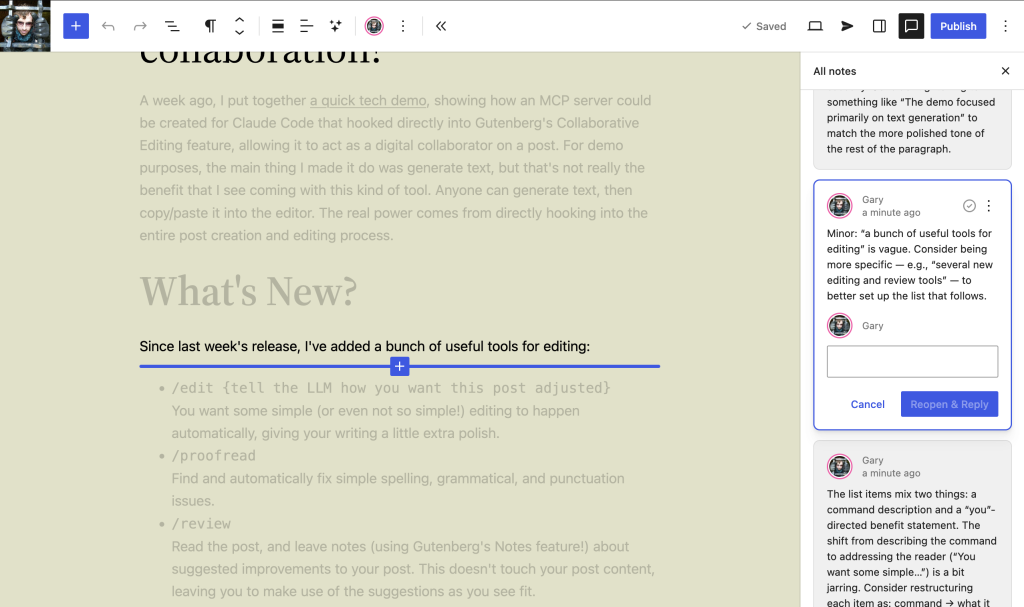
Gary Pendergast, long-time core committer, introduces claudaborative-editing, an MCP server — written by Claude Code, fittingly — that lets Claude edit WordPress posts live alongside you in Gutenberg. Built on WordPress 7.0’s Yjs-powered collaborative editing protocol, your changes and Claude’s sync in real time with no conflicts. A single npx claudaborative-editing setup gets you started. Claude appears in the collaborators list, edits at the block level, and even streams text character by character as it types.
Darin Koster, developer at Fueled, walks you through how AI featured image generation works inside the WordPress AI plugin. One button click kicks off a five-step chain built on the Abilities API: gather post context, generate an image prompt via an LLM, generate the image, optionally create alt text, then import and set it as the featured image — all in about 30 seconds. The post doubles as a practical demonstration of how WordPress’s AI building blocks can be composed into real editor workflows.
In this lively WP Builds debate on AI, content, and the future of WordPress, Jamie Marsland — Automattic’s head of YouTube and prolific WordPress educator — squares off against a gleefully curmudgeonly Nathan Wrigley. Marsland champions the new Claude–WordPress.com integration, which gives AI full context of your site for content, branding, and SEO. Wrigley pushes back on authenticity, AI slop, and eroding community skills. You’ll find both sides genuinely persuasive — and probably switch teams more than once.

As an example of how AI might change how you use WordPress, Jamie Marsland demonstrates that You can now Vibe Code with WordPress.com. on YouTube. He shows what’s possible once Claude is connected to your site via MCP, from building full landing pages and wiring up contact forms with a single prompt to running promotions across multiple sites, generating downloadable SEO reports, auditing for accessibility, and tracking activity with visual dashboards. Think of it as your WordPress workflow, but driven entirely by conversation.
You can learn more about the official WordPress.com connector for Claude in below blog post and video.
- Your AI agent can now create, edit, and manage content on WordPress.com by Jonathan Bossenger
- It’s Official: You Can Now Use Claude with WordPress! also with Jamie Marsland

Questions? Suggestions? Ideas?
Don’t hesitate to send them via email or
send me a message on WordPress Slack or Twitter @bph.
For questions to be answered on the Gutenberg Changelog,
send them to changelog@gutenbergtimes.com
Discover more from Complete Nursing Solution
Subscribe to get the latest posts sent to your email.